×


_extra_large.jpeg)



How to Define and Achieve Hydraulic Fluid Cleanliness
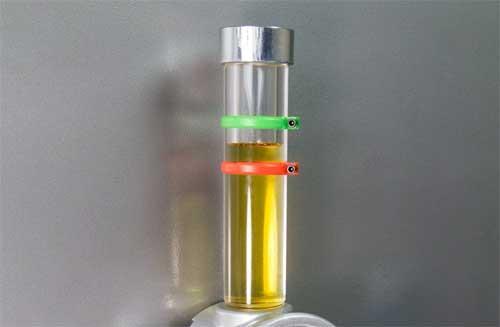
It is widely accepted that particle contamination reduces the service life of hydraulic components. Fact is, some level of particle contamination is always present in hydraulic fluid, even in new fluid. It contributes to the degradation and oxidation of hydraulic fluid itself, in addition to damaging the equipment where it is used.
The level of contamination or conversely, the level of cleanliness considered acceptable, depends on the type of hydraulic system.
So how do you go about defining and achieving a fluid cleanliness level that optimizes hydraulic component life? Consider this example of a normal-pressure system. In Table 1, the target cleanliness level is defined as ISO 16/13.
Once the minimum fluid cleanliness level required for acceptable component life in this system is established, the next step is to quantify the current cleanliness level of the fluid.

Table 1. Typical Fluid Cleanliness Levels for
Different Types of Hydraulic Systems,
Defined According to ISO, NAS and SAE Standards
* Note, the latest revision of NAS 1638 is SAE 4059
(technically identical to ISO 11218).
SAE 749D is currently a defunct standard.
The fluid sample and the condition report indicate an actual cleanliness level of ISO 19/16, well outside the target of 16/13. With this level of contamination, achieving optimum service life for the system’s components is unlikely, therefore, the system cleanliness must be addressed.
As shown in Table 1, there is a correlation between the fluid cleanliness level and the level of filtration in the system. Therefore, the system’s current level of filtration should be checked. But first, the filter performance ratings should be reviewed in more detail.
Hydraulic filters are rated according to the size of the particles they remove and the efficiency with which they remove them. Filter efficiency can be expressed either as a beta ratio for a given particle size or as a percentage of particles captured.
Beta ratio is the number of particles, at the given size, that enter the filter divided by the number of particles that pass through the filter. Filter beta ratios and their corresponding efficiency percentages are shown in Table 2.

Table 2
Filters are also commonly classified according to absolute or nominal ratings. An absolute filter commonly has an efficiency of 99 percent or better at the specified particle size, and a nominal filter commonly has an efficiency of between 50 percent and 95 percent at the specified particle size.
It should be noted that these terms, absolute and nominal, have no standard definition with regard to filter performance and can vary from one manufacturer to another. Filter performance should not be evaluated based on such ratings. To truly evaluate the performance of filters, the beta ratio or capture efficiency, at a given particle size, must be obtained.
According to Table 1, a minimum filtration level of 10-micron with an efficiency of at least 99 percent is required to achieve a cleanliness level of ISO 16/13. This means that unless there is at least one filter in the system with a rating of Beta 10 = 100, it is unlikely that a cleanliness level of 16/13 will be achieved, regardless of how many times the filters are changed.
If a check of the existing filters reveals that this level of filtration is not present somewhere in the system, then either the level of filtration must be upgraded or the target cleanliness level must be revised downward.

Figure 1. Hydraulic Fluid Sampling
Don’t assume that the existing filter elements can be automatically substituted with smaller and/or higher efficiency elements. This may increase the restriction (pressure drop) across the filter and consequently the filter may no longer be able to handle its designed flow rate. If this happens, the filter’s bypass valve will open and the filter will be ineffective.
Filter manufacturers publish graphs that plot pressure drop against flow rate (PQ Curve) at a given fluid viscosity, according to an element’s area, blocking size and efficiency. This information should be considered before upgrading the elements in existing filter housings.
Going back to the example, assume that the system’s tank-top mounted return filter is rated Beta 10 = 100. Therefore, according to Table 1, a target cleanliness level of ISO 16/13 should be achievable with the existing level of filtration. So how can the high level of particle contamination in the fluid be explained?
If the contamination control program began recently, the contamination level could be explained by a filter change that is long overdue. If the system’s history is known and the results of the last fluid sample were acceptable, any abnormal source of contamination that may be overloading the filters should be investigated. Keep in mind that particle contamination can be generated internally or ingested from external sources.
A check of the wear debris levels in the fluid condition report may indicate if the level of contamination being generated internally is abnormal. If wear debris levels are above alarm limits, this usually indicates that a component in the system has started to fail. Any metal-generating components should be identified and changed-out.
Common entry points for externally ingested contamination are through the reservoir headspace and on the surface of cylinder rods. All penetrations into the reservoir air space should be sealed and the reservoir breather should incorporate an air filter of three-micron absolute or better. If the reservoir is not properly sealed and/or the breather not adequately filtered, dust can be drawn into the reservoir as the fluid volume changes.
Check that the chrome surfaces of all cylinder rods are free from pitting, dents and scores. Rod wiper seals should be in good condition. Damaged cylinder rods and/or rod wiper seals allow dust that settles on the surface of the rod to enter the cylinder and contaminate the fluid. If it is suspected that the cylinder rods are a significant source of ingression, flexible cylinder boots should be considered to provide an additional barrier to contaminants.
The next step is to change all of the filters in the system. Because the example system’s current fluid cleanliness level of ISO 19/16 is well outside the target, the fluid in the reservoir should be flushed before the filters are changed. This involves circulating the fluid in the reservoir through external filters for an extended period, or ideally, until the target cleanliness level is achieved.
A filter cart is used for this purpose. In its most basic form, the filter cart consists of an electric transfer pump and a set of filters mounted on a trolley.
The benefits of flushing the fluid before changing the filters are that the system will be operating with cleaner fluid sooner, and the new filters don’t have the job of cleaning up the fluid - they only have to maintain fluid cleanliness.
With contamination load minimized, the fluid flushed, and replacement filters of the appropriate blocking size and efficiency installed in the system, it is now possible to achieve the target cleanliness level.
However, maintaining hydraulic fluid cleanliness is a job that’s never done. It involves a relentless cycle of fluid sampling and remedial action as necessary to ensure the appropriate fluid cleanliness level is continuously maintained.
Read more on hydraulic system best practices:
10 Hydraulic Reliability Checks You Probably Aren't Making
The Seven Most Common Hydraulic Equipment Mistakes
How Do You Know if You're Using the Right Hydraulic Oil?
Top 5 Hydraulic Mistakes and Best Solutions