




Twenty-five years ago, the industry had no consistent way to measure a turbine oil’s tendency to form varnish, deposit-control chemistry was poorly understood, and mitigation options were limited and largely unproven. We also did not fully appreciate the many pathways that lead to varnish, or why deposits build rapidly in some parts of a system while leaving others clean. A lot has changed since then. Better test methods, more robust formulations, and field-proven removal technologies have significantly improved how we prevent, detect, and manage varnish in critical equipment. Important unknowns remain. This presentation summarizes the advances that have shaped today’s best practices, challenges misconceptions that still drive the wrong maintenance decisions, and highlights the key open questions that must be addressed to move closer to truly deposit-free operation in rotating equipment.
The lubrication community has spent the last quarter-century building the vocabulary, the test methods, and the chemistry needed to talk about varnish. None of that existed twenty-five years ago. A reliability engineer looking at a sticking servo valve or a tripped turbine had no quantitative way to confirm what they were seeing, no agreed nomenclature for the deposit, and no commercial product capable of removing it from the fluid. Today the industry discusses MPC values the way it once discussed acid number. It is worth pausing to see how far the field has traveled before pointing out how far it still has to go.
What we have learned (2000–2026)
The first big shift was measurement. The Membrane Patch Colorimetry Method began life as an ASTM draft in 2006 and was published as ASTM D7843 in 2012 [1]. For the first time, operators could put a number on something that until then had been described in general adjectives. RULER, RPVOT, FTIR, and UC filled in around it, and root-cause work became something more rigorous than simply guessing.
The second shift was the turbine oils themselves. Twenty-five years ago many turbine oils had shorter useful lives and were more prone to deposit formation. Today the commercially available products are substantially better in both oxidative life and deposit control. Two stress tests drove that change. MHI’s Dry TOST, later codified as ASTM D7873, gave formulators a reproducible way to see deposit tendency under accelerated thermal-oxidative stress and reshaped how additive systems were balanced. The Turbine Oil Performance Prediction (TOPP) test built on accelerated aging conditions but added the standard condition-monitoring suite, RPVOT, RULER, MPC, and FTIR, so that oxidative life and varnish propensity could be benchmarked side by side [2]. The feedback loop between formulators and these two tests produced a step change. Modern Group II and III turbine oils now routinely outperform their predecessors by a significant margin in accelerated bench data, and the field record largely confirms it.
The third shift was treatment. Through the 2000s the industry tried to filter its way out of the problem. Electrostatic units, balanced-charge agglomeration, and depth filters moved insolubles around but did almost nothing to the dissolved degradation products that drive varnish formation. Ion-exchange resins targeting soluble oxidation byproducts became commercially available in 2009 and finally addressed the right molecular fraction. Solubility enhancers entered the market in 2012, and the chemistry took a decisive step in 2018 with the next iteration, a long-term solution that re-dissolves varnish already deposited on metal surfaces while preventing new deposition.
The fourth shift was conceptual. Oxidation is no longer treated as a single failure mode. We now recognize micro-dieseling caused by adiabatic compression of entrained air, electrostatic spark discharge in low-conductivity fluids, thermolysis at hot-spot surfaces, additive–contaminant interactions, and most recently shear-stress deposits formed where high load, high speed, and a thin film converge. Each pathway leaves a different chemical fingerprint and responds to a different mitigation strategy. Treating them all as oxidation, as the field did for years, explains why so many early interventions failed.
The newest piece of the puzzle is the bearing itself. Two recent papers by Jang, Khonsari, Soto, and Livingstone [3, 4] provide the most detailed modelling of varnish on journal-bearing performance to date.
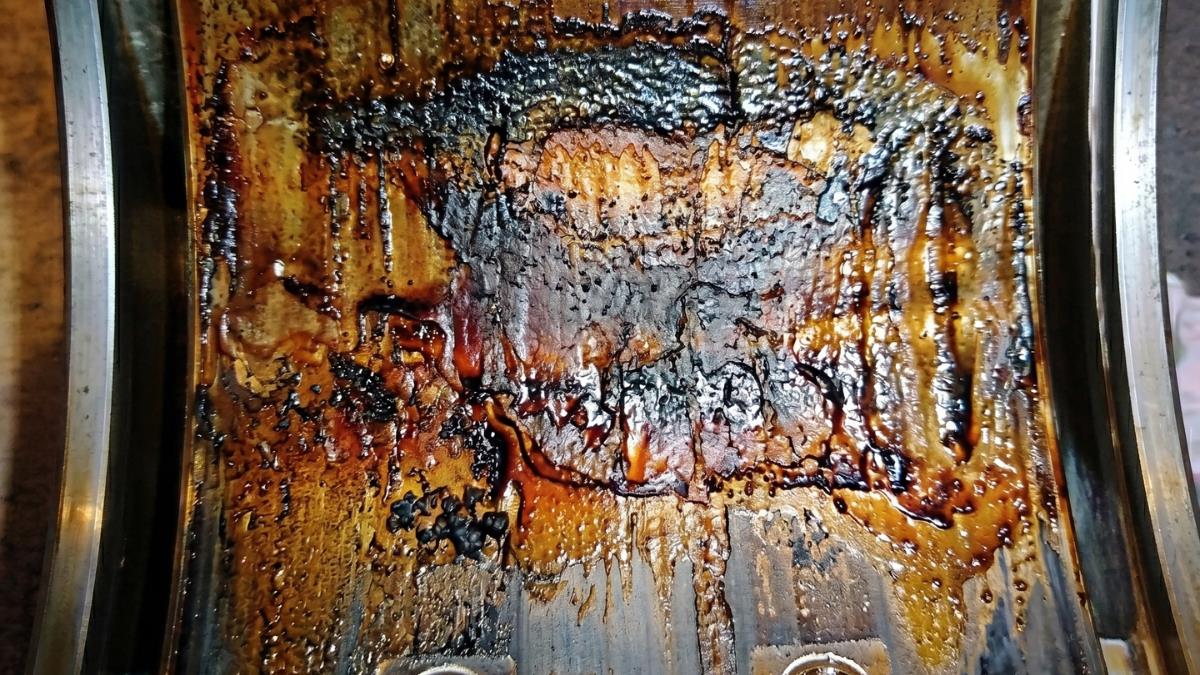
The findings are sobering. The papers’ modeling shows that a varnish layer just twenty percent of the bearing clearance roughly halves minimum oil-film thickness, raises peak hydrodynamic pressure five to eightfold, and lifts bearing surface temperature by twenty-eight degrees Celsius, with another twenty-five added under mild misalignment. Varnish acts as a thermal insulator, dropping local conductivity by two to four orders of magnitude, so the heat the bearing generates can no longer escape into the housing. The threshold of dynamic instability drops by fifteen to thirty percent, meaning a machine designed to run safely at 3,000 rpm may now whirl at 2,600 rpm. Each effect feeds the next: reduced film raises temperature, higher temperature accelerates degradation, more degradation produces more varnish, and the loop closes. Field data confirm the modeling. The sawtooth temperature trace reliability engineers now associate with shear-stress deposits is the macroscopic signature of this cycle, and by the time it appears on a trend chart the bearing has been operating in degraded territory for months.
What we still don’t know
The gaps are larger than the recent advances suggest. Four stand out. First, the unit-to-unit variability problem. Three identical centrifugal compressor trains, same OEM, same fluid, same duty cycle, in the same petrochemical plant. Two operate cleanly for years. The third varnishes constantly. We do not have a satisfying explanation. Subtle differences in flushing practices, start-up frequency, load profile, micro-gas ingestion, or local hot-spot geometry are all plausible, but no one has produced a predictive framework that correlates with real fleet data.
Second, predicting where shear-stress deposits will form. We can describe the conditions in retrospect, high speed, high load, and thin film in Group II through IV base stocks. We cannot yet take a new compressor design and forecast which bearing locations will deposit. Reynolds-equation modeling is a step forward but still assumes a uniform varnish layer rather than the patchy, asymmetric reality found in pulled bearings.
Third, monitoring. MPC does not see shear-stress deposits because the relevant degradation products are consumed at the metal surface, not transported back into the bulk fluid. Standard oil analysis returns clean numbers on a machine actively varnishing its bearings. The industry needs new monitoring chemistry, new sensor modalities, or both. Real-time infrared, dielectric, optical, and acoustic sensors are emerging, but none has yet shown the sensitivity and specificity to replace bench testing for this failure mode. Defining what a meaningful real-time varnish signal even looks like is itself an open question.
Fourth, the hydraulic gap. Almost everything above has been worked out on rotating equipment, primarily large gas and steam turbines and centrifugal compressors. Hydraulic systems experience the same chemistry under harsher conditions, with smaller fluid volumes, more aggressive thermal cycling, and tighter servo-valve clearances. Yet hydraulic users still treat varnish as an oddity rather than a primary failure mode. Mobile equipment, injection molding, and metal forming all show classic varnish symptoms in the field, and the monitoring infrastructure to address them barely exists. Closing this gap is probably the single biggest commercial and reliability opportunity in the next decade of varnish research.
Conclusions
Twenty-five years of work have turned varnish from craft knowledge into a measurable, treatable, increasingly well-understood phenomenon. We have credible test methods, dramatically better turbine oils, multiple effective treatment chemistries, and a far richer model of how degradation proceeds. The frontier has moved from “what is varnish” to “why this machine and not that one,” from “how do we remove it” to “how do we see it forming in real time,” and outward into hydraulic systems quietly suffering the same fate. The next quarter-century will be judged on whether the industry closes those gaps with the same rigor it brought to the first.
References
[1] ASTM D7843, “Standard Test Method for Measurement of Lubricant Generated Insoluble Color Bodies in In-Service Turbine Oils using Membrane Patch Colorimetry,” ASTM International, 2012.
[2] G. Livingstone and E. Rista, “How to Select Turbine Oils Strategically for Improved Results,” OilDoc Conference, Rosenheim, Germany, 2023.
[3] J.Y. Jang, M.M. Khonsari, C. Soto, G. Livingstone, “Effect of varnish on the performance and stability of journal bearings,” Tribology International 198 (2024) 109897.
[4] J.Y. Jang, M.M. Khonsari, C. Soto, G. Livingstone, “Effect of varnish and misalignment on the performance and stability of journal bearings,” Tribology International 219 (2026) 111872.

About the Author

Greg Livingstone is Chief Innovation Officer for Fluitec. He has three decades of industrial lubrication experience focused on how lubricants degrade and to mitigate the risks associated with oi...
Read MoreAbout the Author
About the Author